Showing posts with label Camp Activities. Show all posts

Friday, January 9, 2015

Kids Making Things Happen

All photos courtesy of Beam Camp

Floating Creatura
The title of today’s post is taken from the tagline of Beam Camp. Located in New Hampshire, the camp focuses on developing “capacity for craft, collaboration and compassion through practice of fine and manual arts, innovative thinking, design, creative process, story-telling, building and engineering.” At Beam Camp, staff members include professional architects, videographers, builders, engineers, designers, and creators. Campers have a unique opportunity to work alongside these creative professionals and develop their own creative skills. I first learned about this camp after reading an article featuring them on designboom.com.

Of their various projects shown on their website, I was most intrigued by the latest project, titled “Floating Creatura.” This project is a 20’-long, human-powered floating vessel. The vessel is propelled by a human-sized hamster wheel, bike pedals, and large metal paddles, and is entirely constructed by kids. This brings a whole new meaning to the idea of what kids can create at camp. Read the full article here.

Beam Camper Cabin
The camp’s program focuses on a variety of skills and activities that develop each child’s creative side. Located in New Hampshire on 100 acres of wooded forest, the facilities are also quite noteworthy. The camper village is constructed of nine wood-frame cabins, each with unique floor-to-ceiling screens -- a welcome break from the traditional camper cabin. While their highly-creative, camper-made projects catch the eye of design blogs, the camp also offers some of the more-traditional camp activities, such as swimming and canoeing. As both a design professional and camp enthusiast, it is exciting to see a camp combining the two interests to create a unique experience, helping to develop the next generation of creative thinkers.


Friday, November 21, 2014

More.

When camp is more than fun, friendship and adventure…

A few recent interactions with clients has reminded me of a simple fact: camp is so much more than it is sometimes advertised to be.

Recently I attended the YMCA Camp Marketing and Financial Development Symposium. Greg and I were asked to present the Facilities Needs implications of the results of our YMCA Resident Camps Capital Improvement Study as keynote speakers.

The study, which was completed over several months earlier this year, surveyed roughly 25% of all YMCA resident camps. The survey questions addressed each camp’s current and future capital needs, as well as their current and future camp expansions and improvement projects. Additionally, the fundraising capacity of camps was examined by Lighthouse Counsel, a third-party consultant. Other parts of the study looked at individual camps’ best practices in terms of management and sustainability, as well as determining if market gaps exist nationally for the Y. In addition to conducting the web-based survey, Domokur Architects made eight site visits to select YMCA resident camps throughout the country to get a firsthand look at the camps’ conditions.

While we were at the Symposium, we attended a particularly powerful session lead by Jorge Perez, the VP of Youth Development, Family Enrichment and Social Responsibility at YMCA of the USA. Jorge’s opening analogy especially stuck with me. Let me see if I can recreate it for you...

Imagine that you are back in kindergarten. You are learning about how things grow, and as a project, your class is planting seeds in little seed-starting cups. You add soil, place it on the classroom’s window sill, water it daily, and eventually you have a small sprouting seedling. So, as a kindergartner, what did you learn? You learned that in order to grow, you need three things: the cup, water, and sunlight.

Now let’s apply this analogy to camp. The cup is your camp, and the water and the sunlight are your camp’s investments into youth development. Jorge commented that often camps are only focused on “the cup”: “look at my cup,” "we just built a new cup,” “this cup will be the best.” While it is easy to get lost in this line of reasoning, we all know that camp is about so much more than just “the cup." The cup will not make the seed grow without a strong investment in youth development.

This is something we continue to express through our camp design. Because, while “the cup” is important, it is really about what the cup creates… a second home, a place to learn and grow, the overall experience of summer camp – that is most important.

My next encounter was during a planning discussion with a client. The director expressed her concern that the camp was only being represented as a place for fun. While fun is definitely a main ingredient, camp is so much more. The majority of Camp Directors would agree that the fun is intentional. Activity progressions, programming, and camper-to-counselor ratios are all structured. It has be said many times: the camp environment offers something that can’t be matched. And that is no accident! Successful programs are intentionally invested in youth development, not just fun! As reported in ACA camping magazine…

“Camp directors often design the summer camp experience with intended camper outcomes in mind. Campers often experience positive changes as a result of attending summer camp.”1

Just as successful camp programming requires intentional directives on the part of the camp staff, successful camp planning and architecture must also focus on the investment in youth development with each design.

1Henderson, Karla A., Ph.D, Paul E. Marsh, M.S., Deborah Bialeschki, Ph.D, Margery M. Scanlin, Ed.D, Leslie S. Whitaker, Christopher Thurber, Ph.D, and Mark Burkhardt. "Research: Intentional Youth Development." Research: Intentional Youth Development. American Camp Association, Sept.-Oct. 2006. Web. 08 Jan. 2015.


Wednesday, September 17, 2014

Not Your Parents' Summer Camp

When I first went to summer camp as a kid, it was magical; filled with adventures like rock climbing, horseback riding, and playing in the lake. Now as an adult, working with camps across the country, I enjoy it anew in a new light. So much has changed from my childhood memories, but the emotional experience remains the same. When we work with a new client to identify the needs of their camp, the “magic” of camp is present, reminding us all of the power of camp.

Many parents today might have a similar reaction to new trends in camp programing. Take Pali Adventures for example… recently featured on NBC Nightly News, this is “not your parents' summer camp.” Activities include ATVs, Hollywood stunt training, trapeze skills, and paintball. NBC reports that Pali Adventures has doubled attendance since 2007. Pali Adventures contributes its success to “giving kids what they want.”

This poses an interesting design challenge that can be distilled down into a few simple questions: what do kids want, and how can we give them the tools to articulate and experience those wants? Pali Adventures is just one example of a camp that seems to have successfully combined both questions. Additionally, by giving kids what they want, they are also giving them what they need. Campers' personal growth, willingness to face challenges, and boost in confidence are evident results of the programmatic success of Pali Adventures.

The shift in focus to campers' wants was recently explored during a survey to address the state of camping among one of our current clients. Our survey results report that much of market growth is driven by camper desires. Today’s camper expects more than the average day at “your parents' summer camp.”

Trends in camping could also be compared to trends in technology. According to Victor Luckerson of Time Magazine, “research shows new tools can make kids more engaged and more creative.” In his article, "Disruptive Technology Is Changing How Kids Learn," he references a survey by PBS Learning Media that reports “nearly three-fourths of U.S. teachers use technology to motivate students to learn.” Despite many critics and roadblocks, Luckerson goes on to suggest that while technology can be viewed as a distraction, it can also serve as a tool to meet today’s kids at their level.

Perhaps the same can be said for “extreme activities” at summer camp. Some may view them as “distractions” while others view them as new tools to reach a new generation of campers. The challenge moving forward will be to design camps that will continue to engage kids for years to come.

Luckerson, Victor. "Disruptive Technology Is Changing How Kids Learn." Time.com. N.p., 11 Sept. 2014. Web. 14 Sept. 2014.

Wednesday, September 10, 2014

Loose Parts

For years, camp has offered campers a chance to reconnect with nature and enjoy activities, something often lost in the busy schedules of today’s kids. Take Family Camp on Lake Kanawaukee in Harriman State Park New York for example, where

"dozens of families spend the entire summer here — some for generations — renting rustic cabins and pursuing the same activities across the decades. Despite the social upheavals of the 1960s and the technology revolution of recent years, tradition holds fast… timelessness seems to be the point. Potato sack races on the Fourth of July give way to the canoe regatta in early August, then a square dance”
- Foderaro, "In a New York State Park, a Rustic Summer Camp for the Whole Family" Aug. 22, 2014 The New York Times.

However, according to the ACA, trends in camp programming are changing. The ACA 2013 Emerging Issues Survey reported that camps are adapting to the evolving interests of campers. The study shows that camps are adding programs in areas such as Adventure Programs, Family Camp Programs, Nature/ Environmental Education Programs, and Gardening Programs.

Today’s camp programming is certainly far from the “ad hoc affair” of early camping where campers were “absolutely free to do anything they want to do.” as described by Van Slyck, in A Manufactured Wilderness. According to Michael Thompson, a psychologist, author, and camp consultant, “The loss of time for free, undirected play in everyday life is one of the saddest facts of modern childhood.” Thompson goes on to suggest that perhaps camp is the place where free and undirected play can become a reality.

How can the camp landscape continue to meet the evolving interests of the camper while providing the child with the chance for the unstructured play they need? Camp Vanderkamp in Cleveland, New York seems to be onto something. They have created “an intentional space where imaginations could soar.” This space is filled with “loose parts” such as a boat, crates, logs, rope, and stones. The theory of “Loose Parts” originated in the 1970s from architect Simon Nicholson. The idea that the “loose parts” are the start of the creative process.

What can your campers create with your camp’s loose parts? Forts? Castles? Faraway lands? The possibilities are endless, perhaps all you need to do is give campers the “loose parts” and they will create the rest.


Thompson, Michael, Ph.D. "The Impact of the Loss of Free, Undirected Play in Childhood (And What Camps Can Do About It)." Parents & Families. American Camp Association, 19 Jan. 2010. Web. 10 Sept. 2014.

Van Slyck, Abigail. A Manufactured Wilderness: Summer Camps and the Shaping of American Youth, 1890-1960. Minneapolis: U of Minnesota, 2006. Print.

Monday, August 4, 2014

Falcon Camp: Soaring for Greatness


Cabins built from the ground's trees.
Speechless. Just speechless. I know the redundancy of me telling you how wonderful all of these camps were, but Falcon Camp, in Carrollton Ohio, is one rare find. My journey began on what seemed like an endless dirt road which led to the grounds of the camp. I jumped out of my car and met Dave Devey -the camp director- who graciously shook my hand. I asked that he show me what specific things, places, or characteristics make Falcon Camp unique.My findings are as follows:

First, we explored the cabins. I know what you’re thinking… “Once you've seen one cabin,you've seen them all.” But these peaked my interest.That's because Dave cut down the trees growing on the grounds, made his own lumber, and built a cabin - equipped with handcrafted wooden bunk beds, on the same spot that he cut took the trees from.

Second, he led me to Leesville Lake- the camp's man-made lake that is shaped like a horseshoe. Other than being the best Muskie fishing lake in Ohio, this is where campers can paddle board, sail, swim, canoe, and even participate in log rolling; something I've always wanted to do!

Leesville Lake's log roll.
Next, Dave told me how the campers involved with theater and drama wanted to build a bridge for the upcoming production. At first, he was hesitant, wondering if the cost was worth it; however, he knew that it could double as an actual bridge for crossing the creek so he gave them the “go ahead.”


A handcrafted bridge.
Lastly, Dave shared with me Falcon Camp’s motto: “Fun for now, skills for life.” Dave was positively adamant about how much he values the growth of campers: something that he didn't have to tell me for me to figure out. By that, I mean that it was clear that he truly loves what he does and genuinely cares for each and every person at Falcon Camp. I can easily say that I felt more than welcomed at Falcon Camp. The hospitality and conversations I've had with not only the staff, but the campers were priceless. I don’t think that I've ever met more mature teenagers in my life. So, I want to sincerely thank Dave and Falcon Camp for allowing me to experience such a wonderful camp for a day!

Thank you!

-The Girl with the Red Umbrella

Monday, July 28, 2014

The Camp Christopher Color Run!

An air-conditioned cabin.
Now that I am back in Ohio, I am set to explore camps in the area. I wanted to experience the shift in topography from the Carolinas' extremely mountainous terrain to a more suburban and rolling type of environment. Camp Christopher is my first stop!

Warmly greeted by Amanda, the camp director, our first stop was the day camp area. Equipped with typical playground equipment, some swings and a large open field area, younger campers enjoy not only this space, but several shared areas around the rest of Camp. Next, Amanda took me to one of the cabins near the entrance of the site. This particular cabin was air-conditioned to accommodate some of Camp Christopher's special needs campers. Having not yet visited a Camp on my tour that accommodated such, it was very remarkable to see a Camp that accommodates children with special needs who also makes them feel no different than other Campers and encourages them to participate in many of the same activities.  

A small creek along the trails.
We continued to the horse stables were I got to see the youngest group of campers saddle up and head for a short trail ride. Next, Amanda led me to a hiking trail that included a low ropes course and several great spots to pitch a tent. A small creek along the trail, trickled with water; how relaxing!

Another favorite part of my visit was stumbling upon a plethora of bamboo fishing poles at a lake on site. They weren't your average rod and reel, rather they had only two eyes for the fishing line and a small hook on the end.  Stale bread biscuits were being used as bait.  This allowed younger campers to learn how to fish, without trying to comprehend casting the line and reeling in the fish.  This is just one activity that, as Campers progress at Camp Christopher, they are taught new techniques, eventually working their way up to your typical rod and reel. 

Bamboo fishing poles for the younger campers.
Lastly, and undoubtedly the most exciting moment of my visit, was the color run. Camp Christopher holds their very own color run race every Friday at Camp. They even craft their own paint and powder, used to color the campers as they run! At the starting line, all of the Campers are wearing white t-shirts and as they race through the campsite they are sprayed with colored liquid and powder tie-dyeing their t-shirts with all different colors. When campers reach the edge of camp, they turn around and head towards the finish line. Don't worry moms: everything is machine-washable!! 

The color run!
This camp visit was more than just a walk in the woods… it was a lesson that everybody deserves to have fun and let loose. No boundaries or restrictions should prevent him or her from enjoying life to its fullest potential. Camp Christopher is a shining example of a successful program. Thank you, Camp Christopher!

-The Girl with the Red Umbrella

Monday, July 21, 2014

Camp Ridgecrest and The Little Chief Challenge


I will admit: venturing just a couple miles from Camp Crestridge and onto an all-boys camp was a little intimidating at first. But after pulling up to the office building and meeting Phil, Camp Ridgecrest’s full-time director, I realized how ridiculous that thought was.  I asked the same of Phil as I asked all of the other previous camp directors- if he would be kind enough to show me what makes Camp Ridgecrest unique.  I was interested to see the difference in dynamic, as I shifted from an all-girls to an all-boys camp.

Basketball Court
The first building I entered was the dining hall.  It is actually one, if not the largest vertically-standing log cabin-type buildings in this part of the country. You see, the majority of cabins have logs laid horizontally, while this building's logs stand on end. It is a really unique site to see.

Their lake had TWO blobs!
Another interesting feature was how impeccable their lake was - equipped with not one, but TWO “blobs”, and plentiful kayaks and canoes.  Sharon, back at Crestridge, had told me about this lake, but I didn't fully understand the excitement until actually seeing it.

One tucked-away area that we almost walked past was a small chapel. There were maybe ten benches for small groups to come after breakfast and have devotionals.

Outdoor Chapel
Lastly, Phil explained to me something called the “Little Chief Challenge".  "Little Chief" is the highest rank attainable by a camper. Though, attaining the title sure isn't easy. Eligible campers are woken up at midnight and have to perform a series of assignments.  They have 18 hours to complete numerous physical and mental tasks... without making a sound!  The challenge entails:

a.     Building, starting, and maintaining a fire for 6 hours
b.     Run up Mt. Kitazuma, always remaining in between two other runners (who are constantly being replaced)
c.      Reflect on the meaning of these previous tasks at a devotion center
d.     Write a 1500 word essay after breakfast with the topic, “What Camp Ridgecrest Means to Them” which is to be completed by lunch time
e.     Perform various grueling physical labor tasks

Whether your make it to the 6 PM cut-off or not, the underlying lesson of the "Little Chief Challenge" is that we must fail in order to grow.  Only 3-4% actually complete the challenge, but everyone is right there by your side if you fail.  They are surrounded by an incredible support system and THAT is the true lesson. Thank you, Camp Ridgecrest for an amazing adventure!

Thank you, Camp Ridgecrest!


-The Girl with the Red Umbrella

Wednesday, July 16, 2014

Amphitheaters- Hear All, See All

The Epidaurus Amphitheater in Greece still has near
 perfect acoustics because of the limestone seats which
filter low background noises and enhances higher-
frequency noises from the stage.

The beautiful design concept of amphitheaters has been around for centuries. Meant to be a gathering place of spectators for special events, these venues are an obvious necessity for campsites of all kinds. Large or small, intricately built or simply made- they help bring people together for entertainment, worship, reflection, music and more.

Historically, outdoor amphitheaters were (usually) circular or oval arena, such as Rome’s Colosseum. Outdoor theaters in antiquity tended to be more semi-round. Gladiator fights, chariot races, athletics, and live theatrics were among some of the events held at these arenas. Some able to accommodate over 50,000 spectators, ancient amphitheaters were elaborately adorned and often made of precious materials such as marble and limestone. Regardless of material, all of these freestanding structures contained a central showground with tiers of concentric seating and were built for optimal viewing and sound amplification. 


Today's amphitheaters still mimic the notable characteristics of their historic counterparts. And while some still appear in circular shapes, many contemporary amphitheaters often take on a more semi-circular form. A hilly campsite acts as a perfect, natural amphitheater as seating can be cut or built into steep valleys. Breathtaking views are the perfect backdrop to any presentation, so be aware of your surroundings and pick a picturesque background scene for your amphitheater's location. 


Asking basic questions about your amphitheater needs will help determine what will work best for your camp. What type of activities will be taking place in the arena? Will you need electrical outlets? What time of day will it mostly be utilized? Will you need to install lighting? Do you need a large stage or a small podium? How many people are you looking to seat? Do you need a covered stage? Is the area easily accessible? 

Below are several great examples of different types of modern-day amphitheaters- some of which may inspire your very own!


Camp Barney Medintz 

North Fork Ranch

Camp Okizu

Camp Ramah


B'Nai B'Rith Camp Retreat Center

Chapel Island at Camp Jewell YMCA

The Council Ring at Camp Jewell YMCA

Camp Lee

Forest Home Victory Circle Outdoor Amphitheater

Meadows Inspiration Point at Hoblitzelle Camp and Conference Center

Ray Camp; Joan Kroc Corps Community Center


Monday, July 14, 2014

Paint Wars and More at Camp Crestridge

Thursday was a busy but adventurous day.  An hour down the road was my next stop to two camps: Camp Crestridge and Camp Ridgecrest.  Crestridge is an all-girls camp while Ridgecrest is all-boys.  They are both under the executive management of Ron Springs and are right next to each other.  I headed to Camp Crestridge first and was greeted by Sharon, the program director.  Her lively spirit assured me that I was in for a fun tour.  I requested that she show me everything at camp that makes them unique, and she did just that.

The dining hall was under renovation due to the growing number annual campers, but it still kept that “home away from home” vibe.  Sharon continuously mentioned how much the camp was growing.  More and more girls were wanting to partake in the summer camp experience, and she was thrilled!

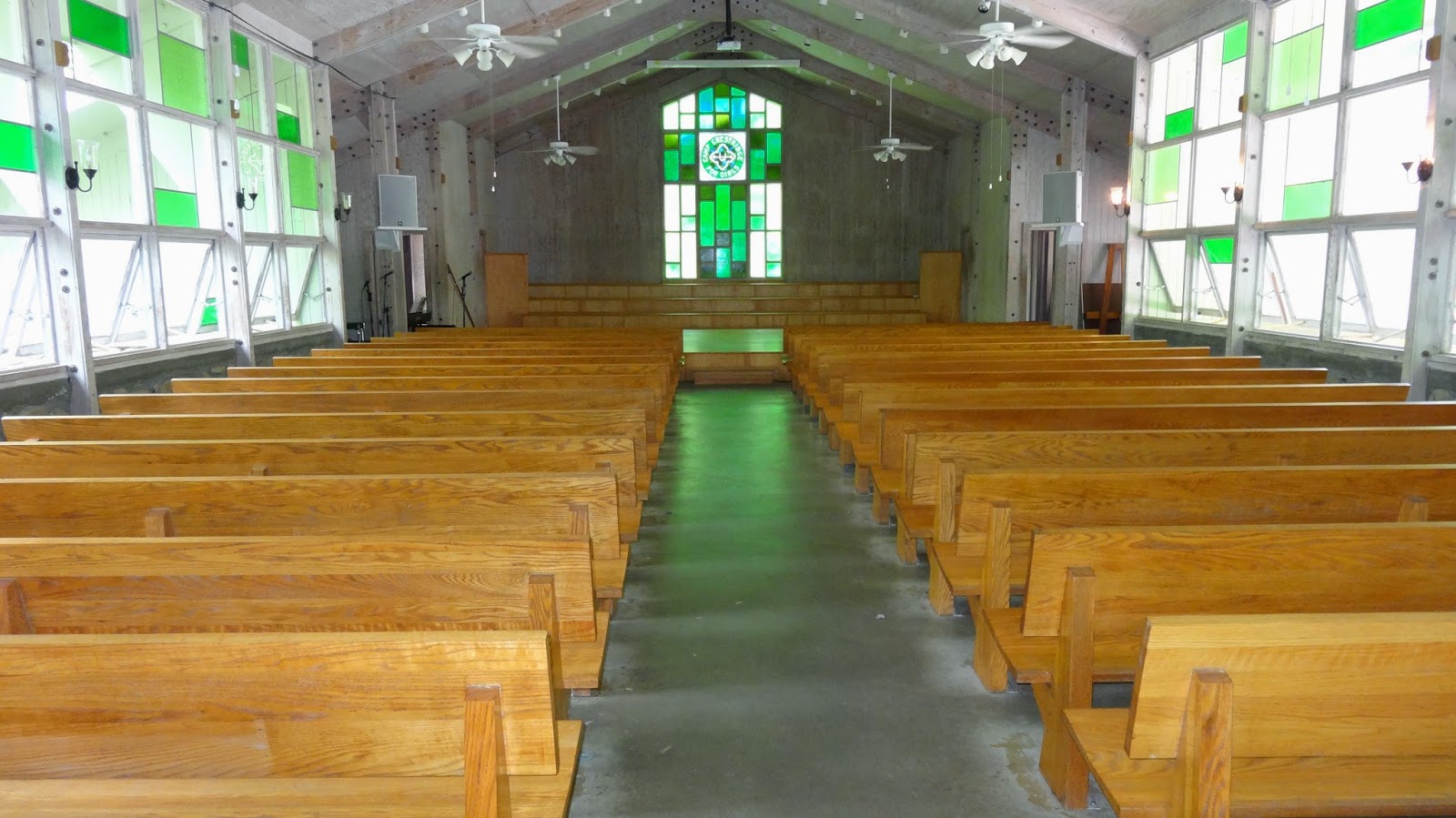
The chapel, beautifully adorned with green and white stained glass.
Another extremely unique and beautiful structure was their chapel.  It was definitely a unique building, with a stunning stained glass focal point at the altar.  Renovations were also under discussion in order to accommodate the (growing) amount of campers.

The paint war is definitely a favorite!
I grew anxious as Sharon informed me about the next activity; something that I haven’t encountered at camp before: paint wars!  Each camper (there were about 70 on this day) is given a white t-shirt and as soon as the music starts, they completely let loose and throw washable paint onto each another.  And what is a paint war without a slip-n-slide?

Lastly, the most interesting building of all was the museum, which was only made possible by funds from alumni.  It contained miscellaneous collectibles from years' past.  What an everlasting way to remember history!

The museum that was built thanks to numerous alumni donations. 
Seeing the youth, especially young girls, bond with one another and create new friendships is surely refreshing.  Merely being in their presence evokes a smile that you can’t quite replicate anywhere else.  The positive and judgment-free atmosphere is contagious.

Extending my deepest gratitude to Sharon and Camp Crestridge is the least that I can do for allowing me a taste of their way of life, and I wish them all the best. Next stop: Camp Ridgecrest!


Thank you, Camp Crestridge!
-The Girl with the Red Umbrella

Monday, June 30, 2014

YMCA Camp Greenville: The Tradition Continues

YMCA Camp Greenville is located right on the border of North and South Carolina near Brevard, North Carolina. Currently in its 102nd year of camping, Camp Greenville has quite the history.  In 1925 Camp Greenville moved to its current site. Camp Greenville sits on 1,400 acres, making it the 5th largest YMCA camp in the country. Originally, Camp Greenville was an all boys camp while the YWCA operated camp Burgess Glen, until the late 1970s. In 1980 the Camp Greenville became coed. Today, Camp Greenville offers one-week sessions to approximately 200 boys and girls per week. The Camp Director, Rick Burris, recently showed me around the camp.


Inside The Lodge
The most tangible pieces of Camp Greenville history are located in the Thomas F. Parker Lodge, originally built by John M. "Uncle Johnny" Holmes in the late 1920s. At the time Uncle Johnny was a member of the Rotary Club and sent letters to Rotary members asking for artifacts from around the world. The amount of history in that building was much more that I could take in during my short visit! Rick pointed out a few of his favorites, including a letter from Gandhi.


As I was walking up the hill towards the seemingly spontaneous dance party that was happening in the airnasium for class change, I spoke had a chance to talk with a returning camper. When I asked him what the coolest thing at camp was, he said the “Monk Secret” of course. Clearly, I needed an explanation.  Becoming a Monk Old Timer is an honor for 5th year campers. The campers explained to me that you can’t really know the secret unless you are a Monk. The tradition got its name from Monk Mulligan, the camp director from 1944-1967. Part of the tradition is a special camp shirt, like the ones below -- the meaning is only known to fellow Monk’s Old Timers.

Photo credit: YMCA Camp Greenville
As I was headed back to the main office, the campers were enjoying the beautiful day swimming at the lake. As I took in the magic of camp, I saw the signs across the lake reading "Be a Great Boy / Be a Great Girl” and I asked if that was the camp motto. Rick said yes, and told me the story behind the saying. The story goes like this. When  Teddy Roosevelt was asked how to be a great man, he replied with, "First you must be a Great Boy." From there the tradition was born and continues today. As I was leaving I even heard the song:
    "Be a Great Boy
     Be a Great Girl
     Be a child of the Lord; it’s the greatest thing in the World
     Do you know the Monk?
     Do you know the man?
     Do you know the power of God is right there in your hands?  
     In your hands…"
The spirit of camping at Camp Greenville is alive! On my way out of Camp, I had one last stop. Pretty Place Chapel. Campers use this place for special chapel services throughout the week. The views were stunning. As I sat on the first row I was thinking about how important this place is to Camp Greenville.  With over 100 years of camping, I wondered how many campers have sat in this chapel. It's amazing how one place can have such an impact on a young person’s life.

-The Girl With the Red Umbrella

Tuesday, June 24, 2014

The Keystone Total Girl

Celebrating its 100th year in 2016, Keystone Camp is an all-girls camp located just a short drive (or bike ride) away from downtown Brevard, North Carolina. The 51-acre site is home to 220 girls per week. Keystone Camp's director, Page Ives-Lemel, is a fourth generation Keystone director. Page grew up at camp and her passion for Keystone is contagious! The camp's mission is to support and develop the Total Girl.

So what makes the Total Girl? Keystone stresses the individual character of each girl at camp. In the small camp setting, each girl has the chance to shine. With over 20 activities from A Cappella to Yoga, with Archery, Horseback, and many more in between, Keystone is about being you!

With the filming of the Hunger Games in nearby DuPont State Forest, Archery is an ever popular activity. The girls even wear the popular “Katniss” braid during archery competitions. Keystone is also known for its Horseback Riding Program. With three riding rings, six miles of trails, a hunt course, and several large pastures, girls can ride every day.


At Keystone, there are no age divisions. Campers learn and play with campers of all ages. It's about creating community. Page even places campers at designated dining tables based on what they have in common. It's about getting the conversation started and building relationships that last a lifetime.


As the oldest girls' summer camp in the Southeast, the history and tradition is alive, but the camp is not standing still. Under Page's leadership Keystone is continually moving forward. In the last few years, many buildings have been replaced, property has been consolidated to protect camp, and the landscape is full of beautiful flowers. Camp has a long tradition of counselors sleeping in a loft above the girls in each cabin.  This allows the girls to feel like they have their own space, while counselors can still see and hear the girls from above. The new cabins which have been built in the past few years still maintain this tradition.

Keystone Camp for girls strives to develop the total girl on an individual basis. From their programming to their facilities to the smiling faces of the campers, this message speaks for itself.

Thank you for an enriching experience, Keystone Camp!


- The Girl with the Red Umbrella


Monday, June 16, 2014

Gwynn Valley Camp: Sustainability at its Finest

Gwynn Valley Camp is located just south of Brevard, North Carolina in the Blue Ridge Mountains.  As the camp is renowned for its sustainability efforts, I was eager to see their green initiatives in action!  Anne and Grant Bullard, the two camp directors of Gwynn Valley, were kind enough to show me around the camp last week.  Anne and Grant have a strong passion for the outdoors, as well as for the intellectual growth of children, and these passions are evident throughout Gwynn Valley.  The rest of the staff comes from around the world – which makes for a diverse, inspiring atmosphere for the kids as they learn to develop appreciation for others as well as themselves.

Gwynn Valley's water mill supplies power all throughout camp.
The most visible sustainable initiative at Gwynn Valley is their historic water mill, which supplies energy to the camp.  Built in 1890, the mill is situated on the edge of a lake where a mountainside creek meets the lake.  The water running down from the mountains generates hydropower that is delivered to many of the camp buildings.

Four wood burners provide the camp with even more renewable energy.  The enticing scent of burning hickory and oak permeated the air throughout the camp – just an added bonus for being green!  Gwynn Valley uses these wood burners to heat up to 70% of their water.

Food production at Gwynn Valley Camp is also highly sustainable.  I was surprised to learn that Gwynn Valley grows up to 70% of their food on-site, including beef and eggs!  There is also a food mill that campers can use to grind corn into cornmeal – and better yet, to churn their own ice cream… YUM.  Currently Anne and Grant are searching for a solution for food waste disposal; they are exploring the option of using Black Soldier Fly Larvae to speed the food decomposition process – and afterwards, the nutrient-rich larvae can become a healthy meal for Gwynn Valley’s chickens.

Thoughtful design solutions, like the ones described above, were all throughout camp.  The walls of the horse barn were even designed to collapse to create winter storage areas for bikes and kayaks – simple, but clever.  And how could I forget the lightning detector?  Grant and Anne decided to invest in a lightning detector as a safety measure; this device can send a signal to the camp staff that alerts them when it is unsafe for outdoor activities.

The stable walls collapse,
enabling more storage.
My first visit was a success!
Thank you, Gwynn Valley!

Gwynn Valley Camp is clearly a place where the three pillars of sustainability (people, environment, and economy) come together. The camp offers a rewarding social experience for campers, earth-friendly initiatives that respect nature, and efficient practices that save time and money for the camp.  Learn more about Gwynn Valley Camp by visiting their website here!

- The Girl with the Red Umbrella


Wednesday, June 11, 2014

food·ie

noun \ˈfü-dē\

: a person who enjoys and cares about food very much
:  a person having an avid interest in the latest food fads

In today's world, food has taken on a whole new meaning. Social Media is full of yummy treats and gourmet creations, created as much for the pic as the palate. Words such as "foodie" are being used to describe the Millennial Generation. As food takes the spotlight in social media and culture, it is no wonder that campers are interested in cooking at camp. In short, Home Economics is now what the cool kids are taking.

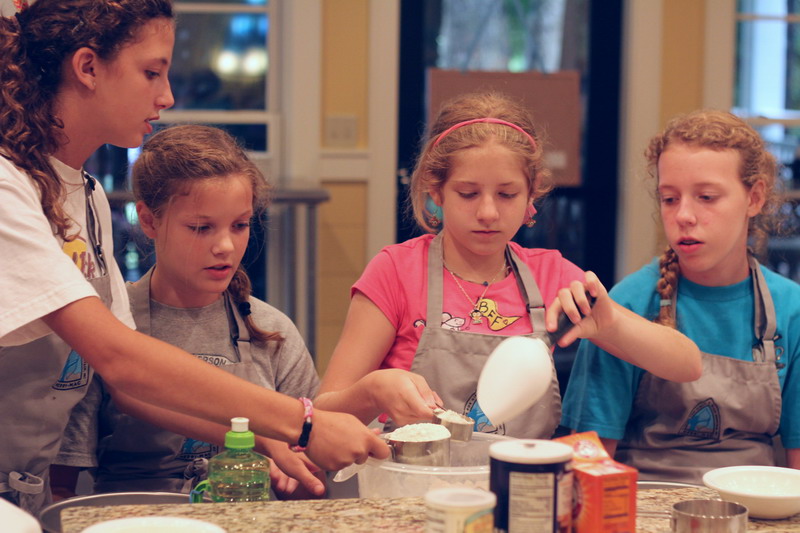
Many camps are adding cooking classes to camp activities. Kids are getting excited about cooking spaghetti, making pies, and baking bread. This poses the design challenge of creating a successful cooking classroom. While using the Camp's Dining Hall Kitchen may not be practical or safe, could a separate, smaller facility be set up for campers? Many camps are building unique cooking classrooms to accommodate the "foodie generation". 

Earlier this year our Camp Design team visited the cooking classroom at Camp Merri-Mac in Black Mountain, North Carolina. During our visit, Director Adam Boyd shared that cooking is one of the most popular activities at camp.  You can learn more about Camp Merri-Mac's cooking program here

The Cooking Classroom at Camp Merri-Mac in Black Mountain, NC
When designing a cooking classroom, there are a few things to consider. How many campers should attend each class? Is food storage separate from your main camp kitchen? How will clean up work? Below are some keys to a great cooking classroom design. 

1. Create a demonstration area large enough for all campers.

2. Spread out appliances, so that not all campers are in the same area.

3. Plan for clean up. (Like Arts and Crafts, this is an essential step.)

4. Provide flexible space depending on appliances needed. Stainless steel rolling tables are a great solution to this.
 

With careful planning and a full understanding of the programmatic needs of the cooking classroom, your camp can successfully host culinary activities. 

Thursday, November 29, 2012

The Program

"Camp Design: Master Planning Basics" Series

Now that you’ve mulled over the Five Keys of your camp, you’re ready for the next major step in master planning: programming.  In the context of a camp master plan, defining programming means exploring two foundational questions:

1)      What is the camp’s purpose?
2)      Who is the camp’s audience?

You’ve likely already explored the first question.  A statement of purpose is the defining characteristic of any organization; it’s the driving force for the organization’s decision-making.  It’s very important to have a clear, simple, and well-articulated statement of purpose to be successful – and it’s essential to incorporate this sense of purpose into your master plan.

The second question, regarding the camp’s audience, is a bit more complex.  There are four major components that comprise the process of thoroughly addressing this question: market research, operational criteria, design factors, and facility requirements.

Water-based activity at Camp Sea Gull in Arapahoe, NC

Market Research

Market research involves gathering and analyzing information about what your customers want, like, and buy.  When it comes to camps, this kind of research can be as informal as chatting with parents and campers, or as formal as a full-blown survey.  Many camps review with staff annually to gain insight into which programs were successful or what kinds of complaints were most prevalent, for example.  These days, there are many tools and resources that make it easy for organizations to do their own market research, too (such as Survey Monkey).  The important thing is to have a strong understanding of the people your camp serves.

Operational Criteria

Sample Program Activity Work Sheet
The following components are the major facets of operational criteria.
  • Service Groups: who the camp serves and their characteristics.  Consider the age range, gender, interests, and background of the people who come to your camp.
  • Program Modes: modes of operation offered.  Is your camp a large-scale weekly overnight summer camp, or a small monthly year-round operation?
  • Program Activities: activities offered.  It helps to classify activities as one of the following: land-based, water-based, climate-based, facility-based, or travel-based.
  • Staff Requirements: defining characteristics of those who run your camp.  Develop a matrix that defines factors like how many staff members you have, in which areas, and their preferences for living and relaxation.
  • Camper Living Concept: the building block of your camp.  You should address factors like how many campers, counselors, and bathrooms are ideal for each unit, what type of accommodation you’ll provide (tents vs. cabins), and how these units will be grouped.
Keep in mind that you’ll likely have multiple expressions for each above category – you might serve both families and girls, offer both land-based and travel-based activities, or maintain both tents and lodge residences.  For this reason it’s very helpful to develop work sheet templates, like the one featured above, for each of the categories and then fill one out for each category expression.

Design Factors

While examining your camp’s audience, it’s important to take note of several design factors that will influence the details of the eventual master plan, and thus how campers interact with your camp.  These factors are:
  • Access and transportation, including travel distance, accessibility, public access, and location;
  • Utilities available for your camp’s use, such as water, sewer, and electric;
  • Support services, such as nearby hospitals, clinics, and fire stations;
  • Codes and regulations, including regulatory agencies and building codes.

Facility Requirements

Land-based activity,
a high ropes course
The final step in programming is to establish the basic facility requirements for the master plan.  The more thorough this step of the planning process, the smarter and more efficient your final master plan will be.  You should clearly define the types of facilities you have and want.  It helps to make a list of all present and future camp facilities, and then label them as phase out, maintain, renovate, or new construction.  Examining the purpose, uses, and capacity for each structure will help you to see where your camp may need to increase or decrease spaces.  And in considering your facilities, it’s also necessary to examine vehicle and pedestrian circulation patterns, address security issues, and consider land management challenges and opportunities.

While all of this information might seem overwhelming, methodically addressing each of the topics listed above will ensure that your master plan is comprehensive, innovative, and smart, paving your camp a path to success.  Our next entry in this series will discuss how to generate a quality baseline evaluation of your camp’s existing resources.

Note: This series is based on Greg Copeland’s book “Camp Design: Master Planning Basics”, which is available for purchase here.  Greg leads Domokur Architects’ Planning and Landscape Architecture team with over 40 years of professional and planning experience.